Small data, proper engineering
The original learning exercise asks several customer-purchase questions using a small Apple dataset. Rather than leave the work as notebook cells, I rebuilt it as a package with a command-line workflow, mixed storage formats, explicit schemas, modular transformations and tests.
The dataset is deliberately tiny and synthetic. Its numerical findings are proof that the pipeline behaves correctly, not evidence about real Apple customers. The value of the project lies in the structure and checks.
Using a tiny dataset makes expected answers easy to calculate independently. That turns the data into a useful test fixture rather than pretending it demonstrates scale.
One interface across three source formats
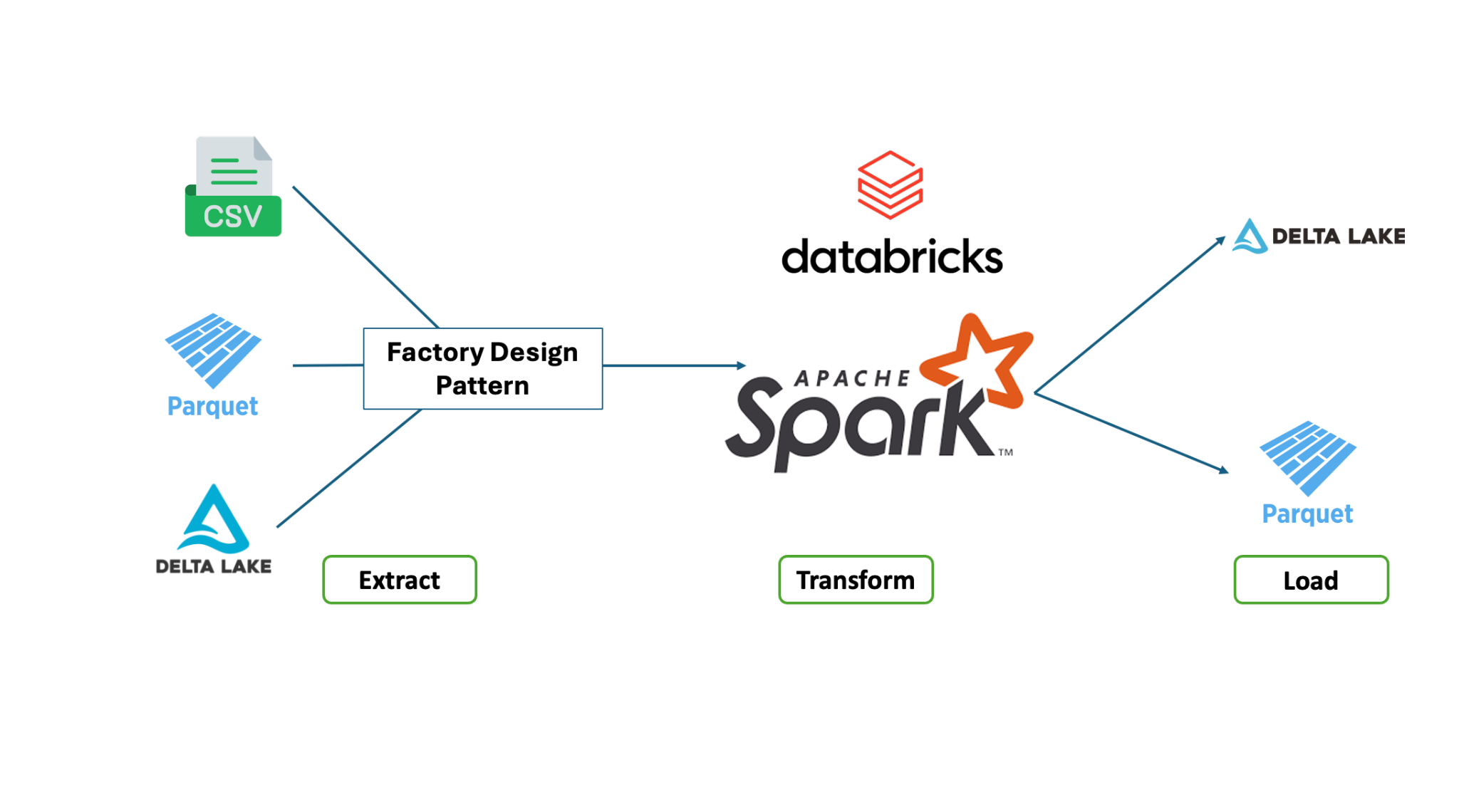
Transactions remain in CSV, customer data is prepared as a Delta table and product data is written as Parquet. A Factory Pattern reader selects the correct implementation while the transformation layer receives consistent Spark DataFrames.
Explicit schemas replace type inference. Spark windows provide deterministic purchase ordering, while broadcast joins are used for the tiny customer and product dimensions.
A source mismatch left visible
The public source uses different names for the same products. The product master contains labels such as “iPhone SE”, “AirPods Pro” and “MacBook Air”, while transactions contain “iPhone”, “AirPods” and “MacBook”. An uncorrected join would match no product rows.
The raw files remain unchanged. During source preparation, the three names are standardised to the transaction vocabulary and the original value is retained in source_product_name.
Null validation
Required identifiers and analytical fields are checked before processing.
Duplicate keys
Dimension keys are tested before they are trusted in a join.
Unmatched dimensions
Customer and product references must resolve after documented standardisation.
Expected answers
Reference results are independently checkable without Spark.
Quietly replacing the raw product file would have made the example look neater while hiding the exact data-quality issue the pipeline needed to handle.
Five workflows, each with a clear rule
- Immediate next purchase: use
lead()over ordered customer transactions to find an iPhone followed directly by AirPods. - Exact product set: use
collect_set()to find customers whose entire history contains only iPhone and AirPods, regardless of order. - Subsequent purchases: rank each customer’s events and retain an ordered list after the first purchase.
- Average delay: calculate the number of days between the qualifying iPhone and immediately following AirPods purchase.
- Top products: join product prices and rank revenue across the supplied records.
The distinction between “bought only these products” and “bought one immediately after the other” is tested directly. Customer 107 qualifies for the exact-set result but not the sequence result because that customer purchased AirPods before the iPhone.
Verified locally, in CI and in Databricks
The repository includes unit tests and a mixed-source integration test, plus a dependency-free Python reference script for checking expected business answers before Spark is installed.
All three notebooks were executed on 16 August 2026 using Databricks serverless compute and a Unity Catalog volume. The run completed source preparation, validation, all five workflows, Parquet and Delta writes and Spark optimisation-plan inspection.
The third notebook is intentionally explanatory. It displays formatted plans for repartitioning, coalescing, predicate pushdown and broadcast joins so optimisation choices can be inspected rather than merely named.